
So I saw Star Trek: Into Darkness at a screening right when it came out, and my initial impression was not particularly favorable, to say the least. I decided, however, to try to put it behind me. It's just my opinion of one movie. It's of no consequence I told myself.
Then, the other night, I had a free ticket I felt obligated to use for it and saw it again. Maybe it'll be better this time. I was probably overreacting I told myself.
NOPE. I was instead enraged all over again.
There have already been a multitude of great articles on how the movie is dramatically bad (http://badassdigest.com/2013/06/12/film-crit-hulk-smash-the-age-of-the-convoluted-blockbuster/) and scientifically bad (http://www.aintitcool.com/node/62867,) and just plain bad (http://io9.com/star-trek-into-darkness-the-spoiler-faq-508927844?utm_source=buffer&utm_medium=twitter&utm_campaign=Buffer&utm_content=buffer2b569.) All I can do is offer up the Top Ten Reasons why I personally found it bad.
10. What's with the volcano?

Never mind the dubious science of the cold fusion bomb and the underwater Enterprise. Never mind the fact that Kirk and McCoy didn't seem to have any good preconceived plan for getting away from the tribe in the first place (why wouldn't Kirk know what their transportation was going to look like?) Think about what we know about Kirk and Spock and McCoy. Now think about the briefing that went on before this whole fiasco started, and realize that the presentation must have gone something like this:
"Here's the plan: We'll fly the Enterprise under water to hide.
"Why won't the tribespeople see us fly down into the water?"
"Maybe we'll go at night or something."
"Why don't we do the whole mission at night then?"
"Shut up. Then, Sulu and Uhura will fly a shuttlecraft into a volcano and dangle Spock from a wire where maybe he'll find a rock or something that isn't totally submerged in lava to set up his bomb."
"The shuttlecraft won't tolerate those temperatures."
"Whatever. In the meantime, Kirk and McCoy will create a diversion so the tribespeople will run away from the volcano, so they won't see all the shuttlecraft/Spock dangling activity."
"Why am I going? What do you need a doctor for this? Why don't you take a security guy?"
"And why am I going in the volcano instead of with the tribespeople team? Does the lava talk? Do the rocks need a translator?"
"Is it logical to have your whole plan hinge on the premise that NOT ONE TRIBAL GUY happens to turn around and look back at the volcano for any reason?"
"Shut up. Then, safe in the knowledge that we've saved the planet, we'll leave and no one will be any the wiser."
"How are we going to leave without them seeing us?"
"Maybe we'll leave at night or something."
"Why don't we..."
"Shut up."
Do you honestly think that the guys we know would listen to that and then say "well alrighty then! Saddle up!?" I don't think so. I think they'd be looking for another plan, right after they demoted the guy who thought it up down to tribble wrangler.
9. Formal Affairs
I just think it's strange that the same organization that made its everyday uniforms look like this:
Then made its dress uniforms look like this:

I grant you that there may be some militaristic reason for making them look this way, but to go from primary colors to a Mao jacket seems like a back-step.
8. Fight Club

So we have one guy who is supposed to be a master warrior, who we already saw (when his face and form were totally obscured) take down a jillion Klingons almost single-handedly with grace and artistry, and another guy who presumably has had extensive training in both Vulcan and human hand-to-hand combat. So why is it, when they have their big fight on top of a runaway vehicle, that all they can manage is to repeatedly slug each other like drunks out in the alley in back of a bar? Did martial arts not make it to the 23rd Century?
I also find Khan's invulnerability a little erratic. Scotty can put him down with a phaser at least temporarily pretty easily, but Uhura can stun him half a dozen times at point blank range and nothing happens? What, did they give her the Easy Bake phaser?
7. Kick the Can

Now we get to the three-quarter mark of the film, when the ship is falling haplessly towards Earth after its 30 second warp from the Klingon homeworld, and they can't start the ship's power back up because the warp core has gotten out of alignment. Kirk bravely dashes into the radiation-filled chamber to go fix it. This takes some time, because for some reason, the most important part of the ship's engineering section has been designed like a jungle gym, with the really crucial part set up like the electronic eyes that keep your garage door opener from working right when the cat nudges one of the sensors. Kirk manages to clamber over to it, and hanging from a pipe, he repeatedly kicks the tilted base to get it into position...
Except he's clearly kicking it the wrong way. He has no leverage, hanging by his hands, so he's reduced to stomping downward, on the side that's already tilted down. In one shot, it clearly moves even further out of alignment, before he finally ends up kicking it from the side and it shoots upright. I don't care how out of it he is, with radiation sickness by then, there's no reason he would just start kicking it randomly, except to draw the scene out to create artificial suspense. But while we're talking about radiation sickness...
6. I'm Not Dead Yet

...Why isn't Kirk dead by this time? In Wrath of Khan, one of the main reasons Spock had to be the one that ran over to the Engine Room to fix the warp drive is that the radiation levels were so high, anybody else would have died before finishing the repairs. Only Spock, with his higher Vulcan tolerance and his science training, had a chance of accomplishing it, making his sacrifice both specific and necessary.
Kirk, on the other hand, barrels in there without any protective gear whatsoever, and stays there for what seems like a pretty long time, during which he's still able to do all the gymnastics needed to fix it. And what kind of technical knowledge is needed here? I'm going with geometry.
5. The Versatile Mr. Chekov

4. KHAAAAAAAAAAAN.
LOL.3. The Trouble With Tribbles
So we get to the dramatic point where Kirk is begging Khan to help him save his ship. Khan, whose supply of altruism was tapped out some 300 years ago, asks what's in it for him. Kirk then makes the worst bluff in history by saying that he will personally guarantee the safety of all Khan's genocidal family. Khan very reasonably points out that Kirk can't even guarantee the safety of his own crew, much less Khan's.At this time, it's evident why Khan is going to help Kirk: Kirk may not be able to grant Khan's crew safety, but it's a pretty safe bet that the Admiral is going to grant Khan's crew the exact opposite. If he doesn't pitch in, everyone, including Khan and his 72 pals is going to die, and Kirk should probably point this out.
Given all this, Kirk thinks, and then responds with "Bones? What are you doing?"
"Oh, just injecting this dead tribble with Khan's blood."
"Huh. Well are you going to help or not?"
WAT.
Leave behind the part where McCoy keeps dead stuff handy in case he wants to inject blood into it, why would Kirk suddenly, at this urgent moment, start talking about tribbles? Has he forgotten that he's trying to convince Khan into not letting everyone die? Does he have ADHD?
2. What do you go for/go see a show for? Tell the truth/you go to see those Beautiful Dames.

Here's a pet peeve I have with the vast majority of movies nowadays. They feel as though they should have a female character in there somewhere--fine. They don't want to get bashed for making the female characters weaker than the male ones, so they make a point of telling us that the women are smarter, stronger, better trained and generally more competent than most of their male counterparts--fine. Having done so, they immediately relax and go back to writing them the way they best know how--as decorative accessories for men.
Take Uhura--although we already know (because she told us in the first movie,) that she's the best of her class and knows more linguistics than her ranking officers, what exactly does she manage to accomplish here? Most of her scenes revolve around her 1) being worried about Spock; 2) being angry with Spock; 3) pouting about Spock; 4) sucking face with Spock. She does get one big moment where she demands a chance to go resolve things with the Klingons because she's the only one who can...except she can't, and would have got summarily killed if Khan hadn't conveniently shown up to rescue her.
Nevertheless, she is a pretty girl, and as such she's also shoehorned into as many shots as possible, even if there is no apparent reason for her to be there. Sickbay? She's there. Engineering? She's there. Any time anyone has a conversation on the Bridge? She's in the background. Is she ever at her console? No wonder their hailing frequencies are always jammed. She's less a Communications Officer and more a serial Photo Bomber.
Of course she does make out better than Carole Marcus, but frankly even the thought of that character OH GOD, THE PAIN, THE ANGER, BLOOD COMING OUT OF EARS, FLAMES AROUND THE FACE...
1. You can't make anyone love someone by wishing.
In Aladdin, the Genie states that there are three rules to wishes: You can't kill anyone, you can't bring anyone back from the dead, and you can't make anyone love someone.
Back when Wrath of Khan came out, life was very different from what it is today. There was no internet--no twitter--to keep you constantly updated when anyone involved with any particular project around the world signed a contract or sneezed. If you wanted to know what was going on with WoK while it was filming, it was pretty much Starlog or bust.
What you did know, is that it had been ten years between the last year of Star Trek, and Star Trek: The Motion Picture...and that picture had not been considered a financial success. Now, three years later, it seemed pretty likely that Star Trek II: The Wrath of Khan was going to be it for Star Trek. Word was that Nimoy no longer wanted to play Spock and had requested he be killed off as part of his agreement to come back (he later stated that this was completely untrue.)
[Aside: This is probably why new viewers don't fully understand what a fake-out the beginning of WoK is. Going in, everyone pretty much knew Spock was going to die...but we didn't know how. During the Kobayashi Maru, when the explosions hit and Spock goes down, the audience in the theater GASPED...because we didn't know! Maybe that was it! Maybe he was dead!]
So when we saw Spock die in the end of WoK, we were looking at, as far as we all knew, the absolute end. There might never be another movie, and if there was, Nimoy wasn't going to want to be in it. It was the finish to a character some had been following for around fifteen years--longer than a lot of real life people you might know. The event had both significance and permanence.
Which is why, when young, alternate-timeline Kirk breezes into the radiation chamber, instead of the heart-sinking foreboding we might have had when Spock did it, our reaction is more OH NO YOU DIDN'T. He's clearly not going to die in any meaningful way--the films have been too successful not to spawn sequels, and they're not going to go on without Kirk.
If it was just that they wanted to do a brief call-back and then go on with the subsequent fight and resurrection, it might not have been that bad. Unfortunately, they chose to linger on the moment, replaying the scene as close as they can to the WoK one. You know what it feels like? It feels like someone trying to make you feel bad about their gerbil dying, by saying it's just like when your grandmother died. No matter how you felt about your grandmother, it gives the unpleasant after-taste of emotional blackmail--using your reactions about something in your history to fuel an emotional response to a completely new event.
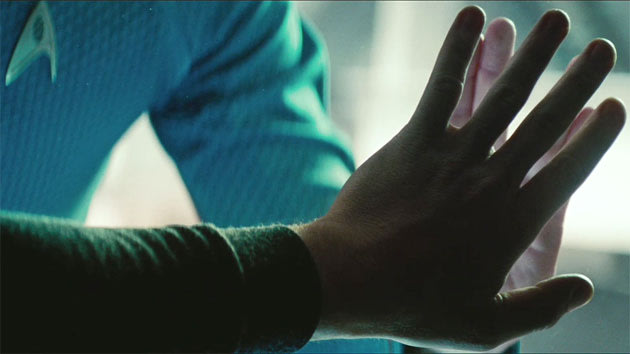
I think these actors do a perfectly reasonable job, and with time and good writing they could easily become as well-associated with their characters as the originals. But they haven't yet--right now, they're still strangers, wearing the faces of people we used to know. To try to exploit the reactions that WoK legitimately generated ultimately fails in ID, because it tries to graft that emotional resonance onto characters that simply haven't earned it.
Sorry Into Darkness. Maybe you can kill someone, and maybe you can bring them back from the dead...but you can't make us love you.

No comments:
Post a Comment